

• PEER REVIEW
Peer review in façade consultancy refers to an independent, expert evaluation of façade design, engineering, or execution by a third-party façade consultant who is not involved in the original design.
The goal is to verify the compliance, safety, and performance of the proposed façade system. For example, if the executing agency proposes a toggle system instead of a cover pressure plate system as per tender, a peer review consultant may be brought in to assess whether this change is safe, suitable, and compliant.
We conduct a comprehensive review of façade design and DBRs, Design Basis Reports, prepared by consultants to identify areas for improvement.
- Design Optimization – Enhancing the performance, aesthetics, and functionality of façade systems through meticulous analysis.
- Performance Assessment – Verifying compliance with structural, thermal, acoustic, and weatherproofing requirements.
- System Validation – Ensuring proposed façade systems align with project specifications and client expectations.
- Compliance Check – Validating designs against local building codes, industry standards, and environmental regulations.
- Integration Review – Ensuring seamless integration of façade systems with overall architectural and structural designs.
Design Brief Process
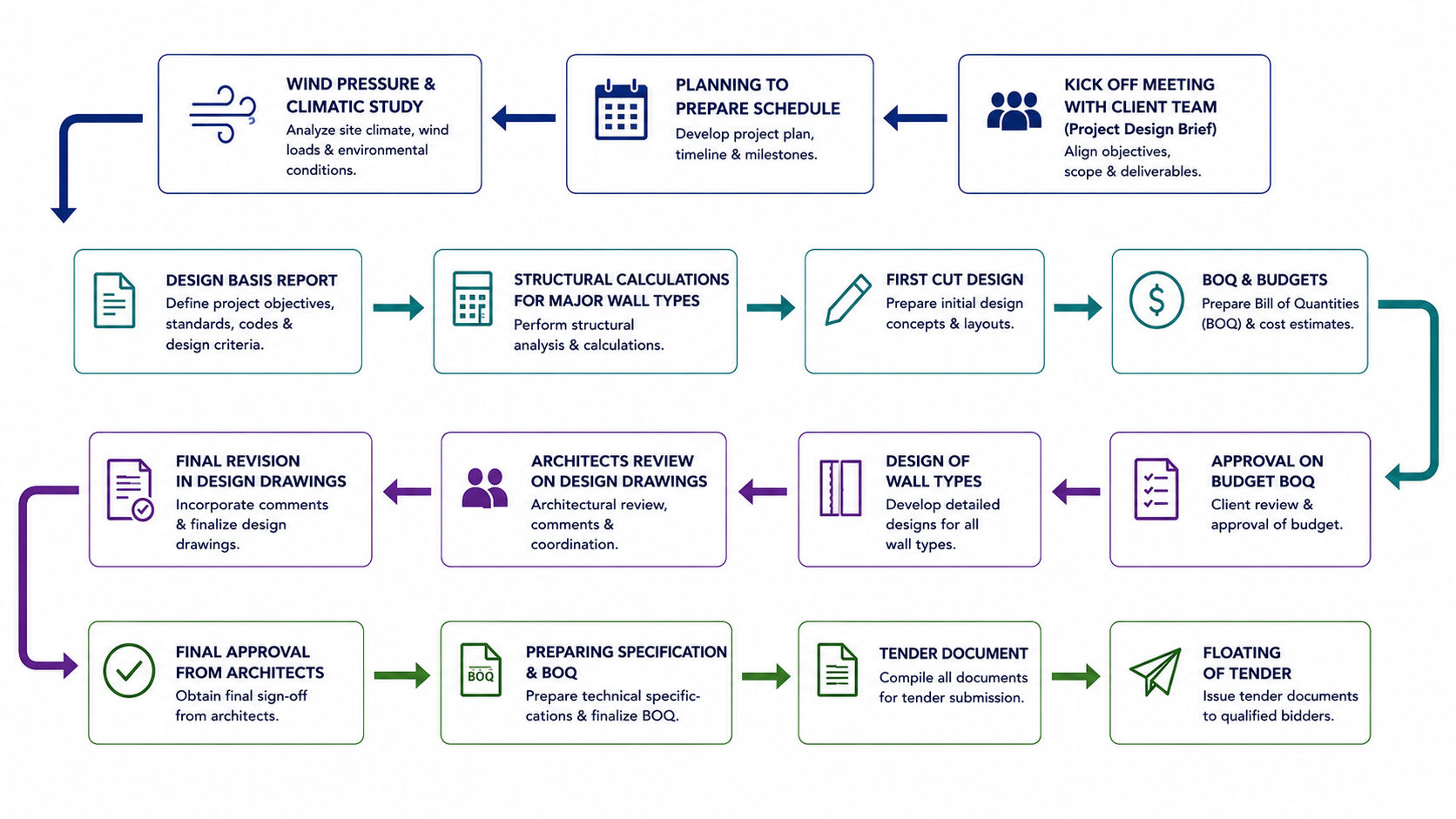
As per NBC Code 8, Peer Review and Quality Audit are mandatory for projects with a façade area exceeding 2,500 square meters, ensuring compliance with industry standards such as IS 875 Part 3 for wind load calculations, ASTM E1105 for water penetration testing, and AAMA 501.2 for field testing of façade systems.
Peer review is essential in façade engineering as it enhances design accuracy, ensures compliance with safety and performance standards, and mitigates risks associated with structural failures, air and water infiltration, and thermal inefficiencies.
It plays a crucial role in optimizing material selection, improving long-term durability, and achieving cost-effective, high-performance façade systems through value engineering.
Why Peer Review Is Important?
At Proactive Facade Management Solutions Pvt. Ltd., we provide Façade Peer Review services to ensure your building envelope is safe, efficient, and compliant. Here’s why it matters:
- Ensuring Structural Integrity & Safety – Façade systems must withstand wind loads, seismic activity, and environmental factors. Peer review helps identify potential weaknesses before construction begins.
- Compliance with Codes & Standards – Building regulations and energy efficiency standards vary by region. Peer review ensures alignment with local codes, fire safety regulations, and sustainability requirements.
- Performance Optimization – Experts evaluate thermal performance, water infiltration resistance, acoustic properties, and durability to improve energy efficiency and occupant comfort.
- Innovative & Cost-Effective Solutions – Peer reviewers can suggest alternative materials, construction methods, or detailing approaches to enhance performance while reducing costs.
- Quality Control & Error Prevention – A second opinion from experienced professionals minimizes design errors and prevents failures, resulting in higher construction quality.
- Risk Mitigation – Identifying flaws early reduces legal liabilities, warranty claims, and costly post-installation repairs.
- Enhancing Aesthetics & Functionality – Experienced reviewers provide input on visual impact, daylighting strategies, and architectural integration.
Conclusion
Peer review in façade design is not just about checking compliance; it enhances safety, performance, and innovation. It fosters collaboration among architects, engineers, and consultants, leading to smarter and more sustainable building envelopes.
Some of the Important Codes
- IS 875 Part III 2015 and NBC 2016 – Code of Practice for Design Loads, Other Than Earthquake, Wind Loads.
- IS 8147 1976 – Code of Practice for Use of Aluminium Alloys in Structures.
- IS 800 2007 – Code of Practice for General Construction in Steel.
- ASTM E 1300 – Standard Practice for Determining Load Resistance of Glass in Buildings.
- AS 1288 2006 – Glass in Buildings, Selection and Installation.
- NBC 2016 Volume I, Part 4 – Fire and Life Safety.
- NBC 2016 Volume I, Part 6, Structural Design, Section 1 – Loads, Forces and Effects.
- NBC 2016 Volume I, Part 6, Structural Design, Section 8 – Glass and Glazing.